One of the most satisfying aspects of model railways is that the trains move without visible means of human propulsion. To achieve this, one needs a locomotive of some sort.
There are three main ways in which locomotives can move :
a) through electric motors powered by batteries located within the locomotive itself, or
b) from motors power by electricity supplied via the track, or
c) by steam.
The majority of model railways are track powered, and although when I started in the hobby as a teenager, everything was analogue control (the speed and direction of the locomotive depended on the size and direction of the current being applied to the track), these days digital control is available (where coded pulses are sent along the track and decoded by the locomotive). This allows for much greater flexibility for controlling the locomotives (or even several locomotives simultaneously, since they can be sent different coded messages at the same time).
The bane of track powered systems is that they only work when there is good electrical connections between the track and the locomotive. This means that the track has to be CLEAN, and since the natural state of the universe is for things to get dirty, you have to CLEAN the track regularly, until it is CLEAN (assuming you can get it CLEAN enough, which is not always possible).
This is bad enough with an indoor layout, when an hour might be spent cleaning the track (and the locomotive wheels). Imagine what happens when you move outside, and there are hundreds things to get the track dirty.
SO …. having perused the on-line blogs on this topic, I decided the best route to go would be (rechargeable) battery power, controlled via radio.
The advantage of this approach is that I don’t have to buy any units to feed electricity to the track. The disadvantage is that the locomotive has to have a radio-controlled unit fitted to it.
These are not so easy to come by. Very few manufacturers sell electrically powered locomotives with radio control already fitted (for steam powered locomotives, radio control is also required, but such locomotives are an order of magnitude more expensive then electrically powered ones, so remain something for the future). But reading a copy of the G-scale Society magazine, I found an enthusiast in the Cotswolds who was selling three of his radio-controlled locomotives (his wife had ruled that 11 locos were too many), so after some back-and-forth I decided to purchase one.
I agreed the purchase in December, and since I was going to visit my father in January, I agreed that we would come and pickup the locomotive, rather than risk damage in the post.
So one wintery afternoon, my dad and I drove over to the Cotswolds and had tea and teacakes whilst listening to the owner’s tales of many years spent building garden railways.
When it came to bringing it back to Germany, I was (appropriately) travelling by train. However, when we got to the security check at the Eurostar Terminus in London, the suitcase containing the locomotive was picked out for inspection. I had to remove all the carefully arranged packing material and let them test it for explosives (the rechargeable batteries located in the tender were rather suspicious).
I was very nervous that the locomotive would be damaged (there is a delicate cable linking the engine with the tender) but they were very respectful, and everything seemed to be OK.
However, I was relieved when a short test on the living room floor proved that everything was still working:
I also managed to buy two radio-controlled playmobil diesel locomotives at auction in the UK. When they arrived, I discovered they didn’t have the battery pack holders, but a quick search on eBay revealed someone in Scotland who could 3-D print them. One of them also didn’t have a matching transmitter and receiver (they are colour coded) but again, eBay had someone selling three sets of matched transmitter/receivers.
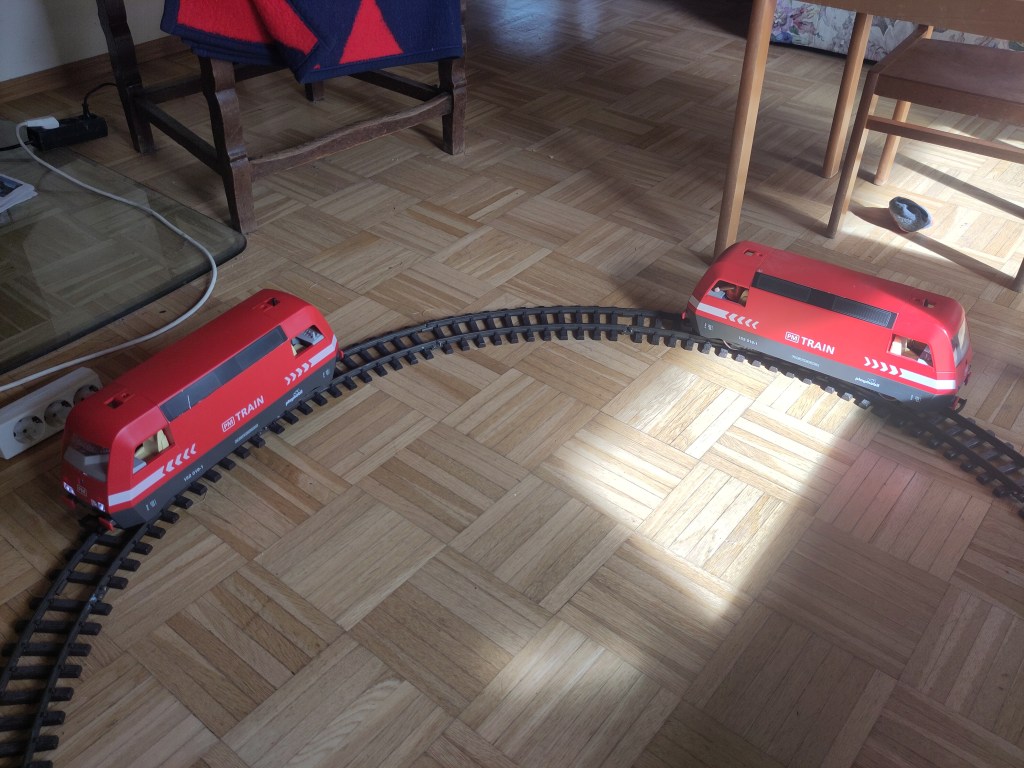
The idea is that they will be available for use by the grandchildren. Now all I need to do is get some serious track laid.


 Proof of the pudding
Leave a comment