We have made it to half-term (or mid-term, as they call it here). Six weeks of teaching done, and now we have a few days break.
On Wednesday this week, all my classes had a test on Unit 2 of the curriculum. Thursday was a compressed timetable before the students leave campus, and not the time to start on Unit 3. A good opportunity for a lesson on the application of mathematics in space….
For this lesson I needed a mock-up of ESA’s Automated Transfer Vehicle (ATV), which was used to resupply the International Space Station (ISS). Here is a photo of ATV:
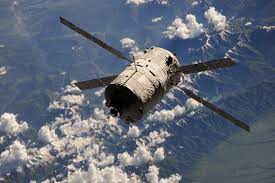
And here is my mock-up 🙂

I showed them some videos of the launch and docking of ATV-3 (there was even a clip of a rather younger looking me, as the Mission Director on console for the launch – see https://www.esa.int/ESA_Multimedia/Videos/2012/03/ATV-3_on_its_way_to_the_ISS#.Y0B8ehPshgI.link around 3m 4s), and some videos of ATV-5 undocking and ATV-1 burning up in the atmosphere.
I explained something of the redundancy systems used on ATV to ensure safety in case of failure, particularly important since human beings are involved. I also explained the principles of centre-of-gravity, and its importance for space propulsion systems.
I then related the story of what happened when I was on console one night, as ATV-3 was being prepared for undocking.
Before ATV was undocked, it was filled with waste (solid and liquid – use your imagination). On the evening in question, there was twice as much waste from the US toilet as the Russian toilet, and we couldn’t load it all into the designated tank, because it would adversely affect the centre of gravity, which had very strict tolerances for undocking (in case the thrusters or control computers failed after undocking; the last thing anyone wants is for a failure to cause ATV to collide with the ISS).
I demonstrated in class using my mock-up how different loading of the tanks would affect the centre of gravity, although my tanks were only filled with coloured water.
I then related that this issue went all the way up the command chain, with spacecraft managers and department heads being woken up in the middle of the night to be briefed in case of a major discussion between the stakeholders the next morning.
In the end, the solution was relatively simple conceptually (although quite complex operationally) – the Russian’s emptied the contents of a tank which had residual water in it, the ATV control centre ‘checked’ the empty tank, and then the Russians (who were in charge of all tank operations and insisted that their waste had priority) loaded the US waste in that tank. This ‘balanced’ the spacecraft, and also allowed the US to dispose of all their waste. Problem solved.


 Proof of the pudding
Leave a comment